Schools
Uranian School
Hamburg School (Witte) — 22 factors, the 90° dial, planetary pictures (A/B=C, A+B−C=D), trans-Neptunian points and Meridian houses; a symmetry reading, not a diagnosis or a forecast.
Calculation frame
- Zodiac
- Tropical zodiac
- Centre
- Geocentric
- Default house system
- Meridian houses
Toolkit
The 14 tabs that open in this school. Tap a title to open the program's own description.
Analysis
The room's 'Analyse' button: the room's approved engines run as one package and give the result first as a GRAPHIC, below it as DETAILED READING sections. Medical: body map (zodiacal man); World: 12-month agenda strip; Relationship: OVERVIEW — a summary of the four analyses (🤝 Synastry, ⚭ Composite, 🧭 Davison, ✦ Coalescent), what each looks at and the 24-month line (detail in each tab); Finance: pressure/support line + capacity bars; Astro-Map: most suitable cities; Horary: 7-day climate from the question moment; Election: 14-day moment quality. Rectification: the ±120-min convergence curve from the event log and the top 3 candidate times (at least 5 dated events needed). Uranian: personal-axis density — bars of the six personal points' tight-picture score against random placements of the same 22 factors (z); below, an axis-by-axis reading, the ten tightest pictures, TNP contacts, starter formulas, 24-month hits (month by month, eclipses included), asteroid highlights when the ✦ extra layer is on, the mirror and the back-test status. New sections: sourced formula matches, the Basic Five axes, the traditional cross-reference (Epstein: the traditional chart first) and, on the tightest pictures, the sourced meaning or a keyword synthesis.
Dial
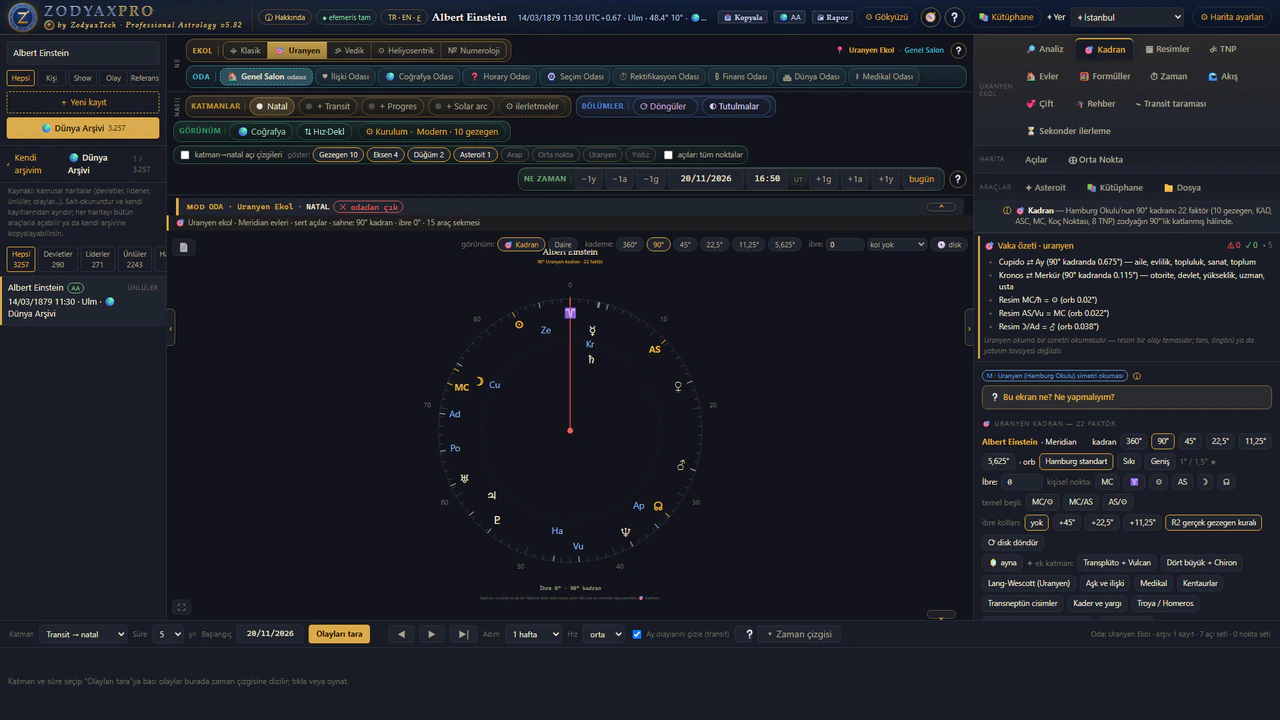
The Hamburg School's 90° dial: 22 factors (10 planets, node, ASC, MC, Aries Point, 8 TNPs) on the zodiac folded to 90°. You bring the pointer onto an axis (usually a personal point); three things are read at that degree: factors on the axis, midpoints sitting on it and the pictures it solves. A symmetry reading; not a diagnosis or a forecast. 🪞 mirror: shows each factor's antiscia/contra-antiscia mirror as a hollow mark on the dial and lists ≤1° matches. ✦ extra layer: optionally adds asteroid/centaur/TNO clusters and Transpluto/Vulcan (at most 14; not in the orthodox Hamburg list). Outer ring: adds the slow transits (TR) of a chosen date or the solar-arc-directed 22 factors (SA) outside the dial; those reaching the same dial position as a natal factor on the inner ring are triggers. If the extra layer is outside the asteroid-file range (1500–2099) a ⚠ warning appears. The Basic Five buttons (MC/☉, MC/AS, AS/☉) bring the pointer to the personal midpoint axes read first in the Ebertin tradition.
Pictures
Planetary pictures (Planetenbild): A/B = C (the midpoint of A and B on C) and A + B − C = D (four-factor symmetry). Sorted by orb, those with a personal point first. Each line shows the school keywords of the factors; the picture is their combination. The ✦ filter: with the extra layer on, isolates pictures containing an extra factor (asteroid/Transpluto). The orb profile (standard/tight/wide on the Dial) also applies to this list. Lines marked 📖 show a sourced meaning (a specific picture record and/or an A/B match in the formula library, the source in brackets).
TNP
The Hamburg School's eight hypothetical trans-Neptunian points (Cupido, Hades, Zeus, Kronos, Apollon, Admetos, Vulcanus, Poseidon): sign, 90°/45° position, declination, speed and their contacts within 1.5° on the 90° dial with the personal points. Not observed bodies; based on the school's rules. Real bodies such as Eris/Sedna are on the ✦ Asteroids tab. The contact orb follows the chosen orb profile (standard 1°/1.5°, tight 20′, wide 3°). Each card carries the TNP description from Epstein's summary, the orbital period and the **traditional counterparts** (the Placidus houses of the matching classical planets, angularity, contact with the TNP, whether the TNP's house is among the matching houses).
Houses
Five Uranian house systems side by side: Meridian (default), Ascendant, Sun, Moon and Node houses. It shows in which house each factor falls in each system; the system is chosen by subject (Meridian: the person's own view; Ascendant: the surroundings; Sun: body/male figure; Moon: feeling/female figure; Node: connections).
Formulas
Sensitive-point formulas: a midpoint (A/B) assigned to a subject. The library holds 45 sourced formulas (Epstein, the Ebertin tradition, the Uranian Society and others; relationships, work, career, property, authority, health, sexuality, hidden matters, mind, education…) — **unfiltered**, whatever the sources contain. Each card shows the formula's sign, 90° position, the natal factors that complete it and the source line; subject buttons filter; completed ones come first. You can add your own formula; with the extra layer on, formulas with asteroids (e.g. Ceres/Admetos) also appear.
Time
Dates when the solar arc (secondary Sun arc, ~1°/year) and slow transits (♃ ♄ ♅ ♆ ♇ + 8 TNPs) hit the six personal points or your formula points EXACTLY on the 90° dial. Conjunction, semisquare, square, sesquiquadrate and opposition count as one hit; the aspect family is written on the line. A year strip on top, a chronological list below. The TU button also adds solar and lunar eclipses as triggers (purple dot). The ✦ extra factors can be chosen as targets (with an asteroid cluster on in the Dial); the extra factors also advance by solar arc.
Flow
The MONTHLY total of the exact hits on ⏱ Time (solar arc + slow transit → the six personal points): the next 36 months, gold = solar arc, blue = transit; the dashed line is the range's monthly mean. A dense month means many triggers; it does not mean an event will happen. Below, the 3 densest months and the hit dates in those months are listed.
Couple
The 22 factors of two charts on one 90° dial: A (the open chart) gold/grey, B turquoise. It lists the common axes (A–B pairs at the same dial position), the pictures where the cross midpoint of an A and a B factor sits on a third factor, and the cross version of the starter formulas (A's ☉ × B's ☽…). There is no score or compatibility grade.
Midpoints
Midpoint trees (Ebertin / Uranian tradition): the pairs whose exact midpoint falls on each planet. The notation 'X = A/B' says that X carries the combined meaning of A and B.
Asteroids
✦ Asteroids tab: every asteroid, centaur and trans-Neptunian object (Eris, Sedna…) in the program in one list — cluster filter, ephemeris file present/missing status, position·house·declination for the selected person, keyword and source code. The 'show on wheel' box adds the asteroid to the wheel, to the Points/Aspects lists and to the open layers.
Aspects
The list of aspects in the open chart: natal aspects and the aspects each open layer makes to the natal points. The 'Aspect set' in the top bar decides which aspects count.
Transit scan
The Ebertin transit scan of the Uranian room: the classical-aspect hits of the transits of the Sun, Mercury, Venus, Mars, Jupiter to Pluto and the lunar node to the natal personal points (Sun, Moon, Mercury, Venus, Mars, Ascendant, Midheaven).
Secondary progressions
The secondary-progression tab of the Uranian room: by the one-day-one-year rule, the classical-aspect hit dates of the progressed Sun, Moon, Mercury, Venus and Mars to the natal personal points (Sun, Moon, Mercury, Venus, Mars, Ascendant, Midheaven, lunar node).
Together with the rooms
The Uranian and Vedic schools open in a room only when their own toolkit is defined for that room.
The school's guide
The 🎓 Guide tab of the school room explains the method in 13 steps:
0 · Analysis first
On 🔎 Analysis the picture density of the six personal points shows as bars and is compared with random placements of the same 22 factors: a bar clearly above chance puts that axis forward, otherwise it is 'within chance'. Below come the tightest pictures, TNP contacts and the 12-month hits.
1 · Set the dial
The 🎯 Dial shows the 90° dial: the 22 factors (10 planets, node, ASC, MC, Aries Point, 8 TNPs) are folded into 0–90°, so conjunction, square and opposition fall on the same spot. Drag the pointer or type a degree to bring it onto an axis. With the outer-ring buttons see the transit or solar-arc positions of a chosen date outside the dial. With the pointer-arms button open the cross arms (+45°, +22.5°, +11.25°); clicking a factor on the dial moves the pointer there.
2 · Start from the personal points
Reading starts from the six personal points: MC, Aries Point, Sun, ASC, Moon, North Node (in that order). Bring the pointer onto one and read three levels: factors on the axis, midpoints sitting on it, pictures it solves.
3 · Read the planetary pictures
🖼 Pictures lists A/B = C (the midpoint of two factors on a third) and A + B − C = D (four-factor symmetry). Pictures with a personal point come first; the smaller the orb, the tighter the picture. A picture is an event theme, not a verdict. The R2 button switches the 'at least one real planet' rule (Epstein) on and off: when on, pure-TNP pictures are dropped.
4 · Know the trans-Neptunian points
☄ TNP lists the eight Hamburg points (Cupido…Poseidon): sign, 90° position, declination, speed and contacts with the personal points. These points are hypothetical (not observed bodies); the reading rests on the school's rules.
5 · Look at the Uranian houses
🏠 Houses shows Meridian (default), Ascendant, Sun, Moon and Node houses side by side: in which house does each factor fall in each system? Meridian houses describe the person's own view, Ascendant houses the surroundings.
5b · Formulas (sensitive points)
🧮 Formulas holds midpoints assigned to a subject (initially the marriage point and the Cupido ones). See which factor completes it in the natal, or add your own formula.
5c · Time wheel
On ⏱ Time choose a year range: dates when the solar arc and slow transits hit the personal points or your formula points exactly appear on the strip and in the list. A date is a trigger moment, not a forecast.
5d · Flow
🌊 Flow draws the monthly total of the exact hits on ⏱ Time for 36 months and lists the 3 densest months with their hit dates. A dense month means many triggers, not an event forecast.
5e · Couple dial
On 💞 Couple search B by name: the 22 factors of two charts on one dial; common axes, cross pictures and the cross marriage/Cupido formulas are listed. There is no score or compatibility grade.
6 · Midpoint trees
In the ⊕ Midpoints tab turn on ☄ TNP: every midpoint sitting on an axis is listed as a tree.
7 · Asteroid layer (optional)
The Hamburg School uses no asteroids; the Lang-Wescott extension adds them to the dial. Pick a cluster with the ✦ extra-layer buttons on the 🎯 Dial (at most 14 extra factors): extra factors are marked ✦ on the dial and in the pictures. Use the ✦ Asteroids tab to see them on the wheel.
8 - The stage: the main dial
In the Uranian school the main stage is now the 90-degree dial (v5.53). The stage bar is in your hands: view (Dial / classic Circle), step (360, 90, 45, 22.5, 11.25, 5.625), pointer arms and disk mode. Drag the pointer, type the degree or click a factor. The stage and the dial tab in the right panel share one state. With no person selected the 14-factor local dial is drawn (no TNPs); pick a person for all 22 factors and the pictures. The reading order is unchanged: the pair symmetric to the axis first, then the axis-focus factor.
Other schools
The information on this page is taken from the ZodyaxPro program's own files.
ZodyaxPro + Training
The program and a 4-month live training together
Purchase options are on our official sales portal.
Purchases are made through our official sales portal, ezoterikmarket.net. This site does not sell anything.